 SimpleACME
vod2pod-rss certificates.
One DNS setup. Easier renewals.
Give your existing vod2pod-rss HTTP deployment a trusted HTTPS endpoint with SimpleACME and Traefik. Keep your normal DNS API credentials off the renewal host, avoid an HTTP challenge listener, and reuse the same challenge CNAME for later renewals.
Prepare your vod2pod-rss domain →Gateway integration for the browser/API endpoint. This is not a claim of a native vod2pod-rss ACME plugin or a complete application installation.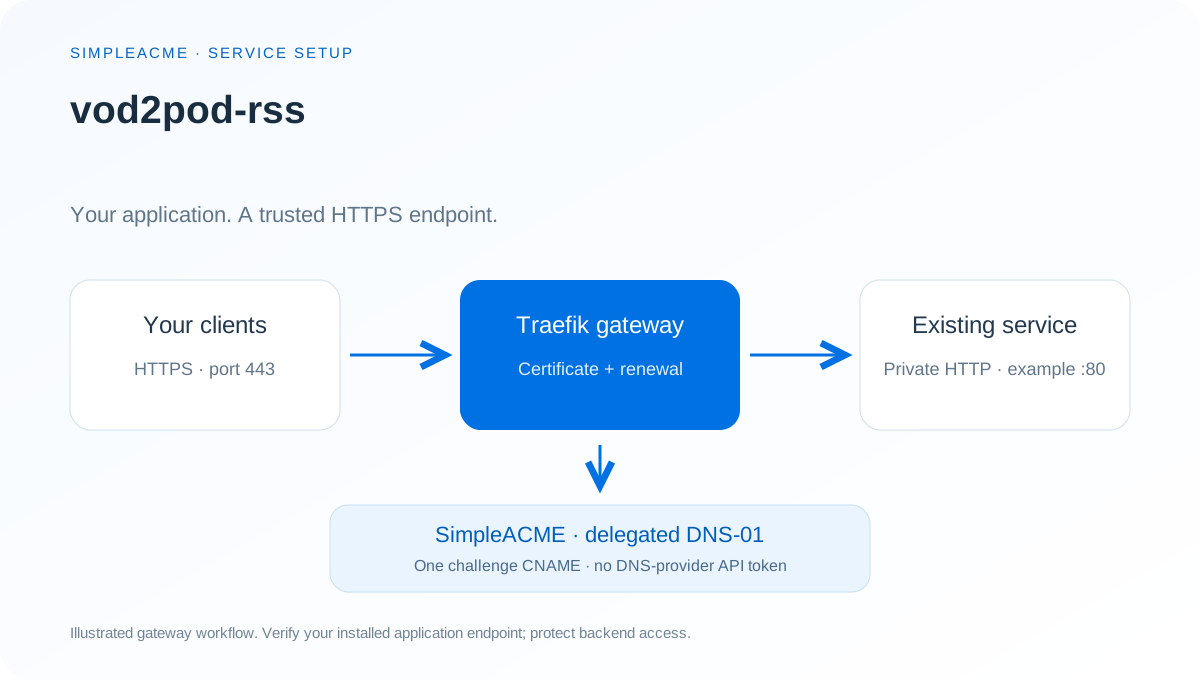
Why put vod2pod-rss behind this certificate workflow?
Convert YouTube and Twitch channels to podcasts, no storage required. Transcodes VoDs to MP3 192k on the fly, generates an RSS feed to use in podcast clients.
For a private vod2pod-rss deployment, maintaining public port-80 validation just for renewal can add routing work. A native DNS-01 client can avoid that listener but may need a supported DNS-provider integration and its credentials. SimpleACME is our preferred option when you want a permanent challenge delegation and one renewal workflow across different services.
Keep application access controls, backups and network policy in place. This guide adds an HTTPS endpoint to an existing service; it does not install vod2pod-rss, provision its database, or make an unauthenticated application safe to expose.
Configure vod2pod-rss step by step
Check the existing vod2pod-rss endpoint
Keep vod2pod-rss installed using its upstream deployment instructions. The linked source includes an example listener or published HTTP endpoint on port 80. Confirm your own private endpoint from the gateway host before copying the router. The port is a documented example, not a universal default for every version or installation.
Choose the HTTPS hostname
Use a dedicated hostname such as vod2pod-rss.example.com at the domain root. Make it resolve to your gateway for your clients, using private DNS if appropriate. Keep the application backend reachable only by the gateway and preserve the application’s authentication.
Prepare the domain and permanent CNAME
Add the intended hostname in SimpleACME. A single-domain demo can prepare DNS before payment and cannot send TXT updates. Copy the exact _acme-challenge owner and assigned CNAME target from the domain card into your authoritative public DNS, then use Check CNAME.
Connect the certificate renewal client
Activate the matching paid domain, then configure Traefik’s simpleacme certificate resolver using the subscriber Traefik guide. Preseed the ACME-DNS account file with that domain’s existing credentials. The public /register route is closed; the client must reuse its registration. Use staging first.
Align vod2pod-rss with the HTTPS origin
Use vod2pod-rss.example.com as the public origin for this vod2pod-rss deployment. If your installed version exposes a public/base URL, allowed-host, callback or trusted-proxy setting, configure it using the linked project instructions. Trust forwarded headers only from the actual gateway. The gateway fragment below does not change vod2pod-rss configuration or install the application.
Add the vod2pod-rss HTTPS router
Merge the named router and service below into the file watched by your existing Traefik file provider. Replace the example hostname and documentation address 192.0.2.10 with the real hostname and private backend IP; use your actual published HTTP port. Keep existing routers and services.
Verify the complete client journey
After staging succeeds, select the production certificate authority in your resolver. Open https://vod2pod-rss.example.com/ from an authorized client and check hostname, certificate chain and expiry. Test vod2pod-rss login, uploads, WebSockets, API requests and callbacks that your deployment uses. This route covers HTTP traffic; SSH, SMTP, media, discovery and other transports require their own configuration.
Keep renewal and monitoring enabled
Leave the challenge CNAME in place and keep Traefik running with persistent ACME storage and current paid domain access. Monitor DNS challenge activity in SimpleACME and the actual served certificate independently. A TXT change is an authorization event, not proof that vod2pod-rss renewed or installed a certificate.
Check the private vod2pod-rss backend
curl --head --connect-timeout 5 http://192.0.2.10:80/Run from the gateway network after replacing the documentation IP and port with your actual vod2pod-rss endpoint. Authentication responses and redirects can be expected; do not disable authentication to make a test return 200.
vod2pod-rss Traefik router example
# Merge these entries into the file watched by your existing Traefik file provider.
# Requires the simpleacme resolver and your pre-registered ACME-DNS account.
# Replace the hostname and 192.0.2.10 with your real hostname and private backend IP.
http:
  routers:
    vod2pod-rss:
      rule: 'Host(`vod2pod-rss.example.com`)'
      entryPoints: [websecure]
      service: vod2pod-rss
      tls:
        certResolver: simpleacme
  services:
    vod2pod-rss:
      loadBalancer:
        passHostHeader: true
        servers:
          - url: 'http://192.0.2.10:80'
The fragment assumes a websecure entrypoint and a simpleacme resolver already configured by the subscriber Traefik guide. Merge entries into the watched dynamic file rather than overwriting other applications. Replace the sample hostname with the exact paid hostname; keep credentials and certificate storage private.
Verify the trusted HTTPS endpoint
curl --head --resolve vod2pod-rss.example.com:443:192.0.2.20 https://vod2pod-rss.example.com/Replace the second documentation address with the gateway IP and use this after a trusted production certificate is installed. Staging certificates are intentionally untrusted. Do not hide trust or hostname errors when validating the production setup.
Compare ACME validation for vod2pod-rss
| Requirement | SimpleACME + gateway | HTTP-01 | Native DNS-01 |
|---|---|---|---|
| Inbound HTTP solely for validation | Not needed | Port 80 challenge must be reachable | Not needed |
| Normal DNS-provider API credential on renewal host | Not needed; separate challenge credentials | Not needed | Usually a provider credential or authenticated integration |
| DNS host API compatibility | Requires the challenge CNAME, not a native DNS API | Independent of DNS API | Depends on the selected DNS client/plugin |
| Wildcard validation | DNS-01 with appropriate paid coverage and client configuration | Not supported | Supported by suitable clients |
| Recurring DNS configuration | Keep one CNAME per challenge owner | Maintain challenge routing | Maintain credential scope and integration |
| Application integration | Reuse the gateway across HTTP services; configure each app origin | Maintain responder/routing and certificate deployment | Maintain ACME client and certificate deployment |
| Price and dependency | Yearly SimpleACME subscription; gateway and service availability | Can be free with an existing client/CA | Provider and client dependent |
Our recommendation for vod2pod-rss: choose SimpleACME when private-service validation, fewer DNS credentials and a reusable gateway matter most. HTTP-01 remains a valid choice for an already-public responder; narrowly scoped native DNS automation can also suit an existing deployment.
Client guides and application sources
Traefik full configuration · Certbot hooks · Certbot Docker · win-acme PowerShell · AI setup assistant. Complete subscriber assets require active paid access. For native certificate imports, use the application’s deployment documentation and a suitable certificate-deployment hook.
- vod2pod-rss project website ↗
- vod2pod-rss endpoint and deployment source ↗
- vod2pod-rss configuration reference ↗
- Traefik ACME DNS challenge reference ↗
Source review: 2026-11-08. Product versions and deployment packaging change; verify the actual listener and application settings before applying the example.
Software summary from Awesome-Selfhosted’s vod2pod-rss record, licensed CC BY-SA 3.0. Gateway instructions and illustration by SimpleACME. No vendor affiliation is claimed.
vod2pod-rss certificate FAQ
Does SimpleACME issue the vod2pod-rss certificate?
SimpleACME publishes the delegated DNS-01 TXT challenge. In this guide Traefik requests, renews, stores and serves the certificate. The portal does not issue certificates or receive your certificate private key.
Does vod2pod-rss need a native SimpleACME plugin?
This guide uses an HTTPS gateway in front of an existing vod2pod-rss HTTP deployment. It does not require a native vod2pod-rss ACME plugin. Keep the application’s public URL, trusted proxy and callback configuration aligned with the gateway.
Do I give vod2pod-rss or Traefik my DNS API key?
This delegated workflow uses the assigned SimpleACME challenge credentials rather than a normal DNS-provider API token. You still need authorized DNS access for the initial challenge CNAME, and must protect the challenge credentials.
Can vod2pod-rss remain private?
Yes. The gateway needs to be reachable by authorized clients, but a public inbound HTTP-01 listener is unnecessary. The challenge DNS must resolve publicly; the ACME client needs outbound access to the certificate authority and SimpleACME.
Does the example port work for every vod2pod-rss installation?
No. Port 80 is an endpoint found in the linked upstream deployment or documentation example. Confirm your installed service’s actual listener, published port and protocol before applying the router. Development and packaged deployments can differ.
Can I use a wildcard for vod2pod-rss?
Use a suitable paid wildcard domain and DNS-01 client configuration if several service hostnames share a domain. *.example.com matches first-level names such as app.example.com; it does not by itself cover example.com or deeper names.
Does this install a certificate inside vod2pod-rss?
The example terminates TLS at Traefik and uses a private HTTP backend. It does not import a certificate into the application or encrypt that backend hop. Native TLS, end-to-end encryption and non-HTTP transports require the project’s certificate deployment instructions.
Will certificate renewal continue automatically?
Keep Traefik running with persistent ACME storage, the permanent CNAME, network access and an enabled paid domain. Monitor both renewal errors and the certificate served to clients. Existing certificates remain valid until expiry; a challenge update alone does not prove successful renewal.
More vod2pod-rss setup resources
Search all service guides → · Find your DNS host’s CNAME guide →
Your next certificate. A little less complicated.
Keep your DNS provider and your ACME client.
Prepare your domain before activating paid updates.