 SimpleACME
An invalid request-header response from a DNS API means the client failed while presenting the TXT challenge, before the CA checked the record. Inspect token type, expected environment variables, accidental whitespace and the provider integration version. Do not expose the token while gathering diagnostics. If the regular zone token is the dependency you want to remove, migrate the challenge owner to an existing SimpleACME registration and keep ordinary DNS with its current provider.
This guide addresses a problem raised in a public r/Traefik discussion. The discussion identifies the question; the runbook below is our own explanation, not a claim that the original poster used or endorsed SimpleACME. Read the source discussion for its historical context and compare it with the current client documentation linked below.
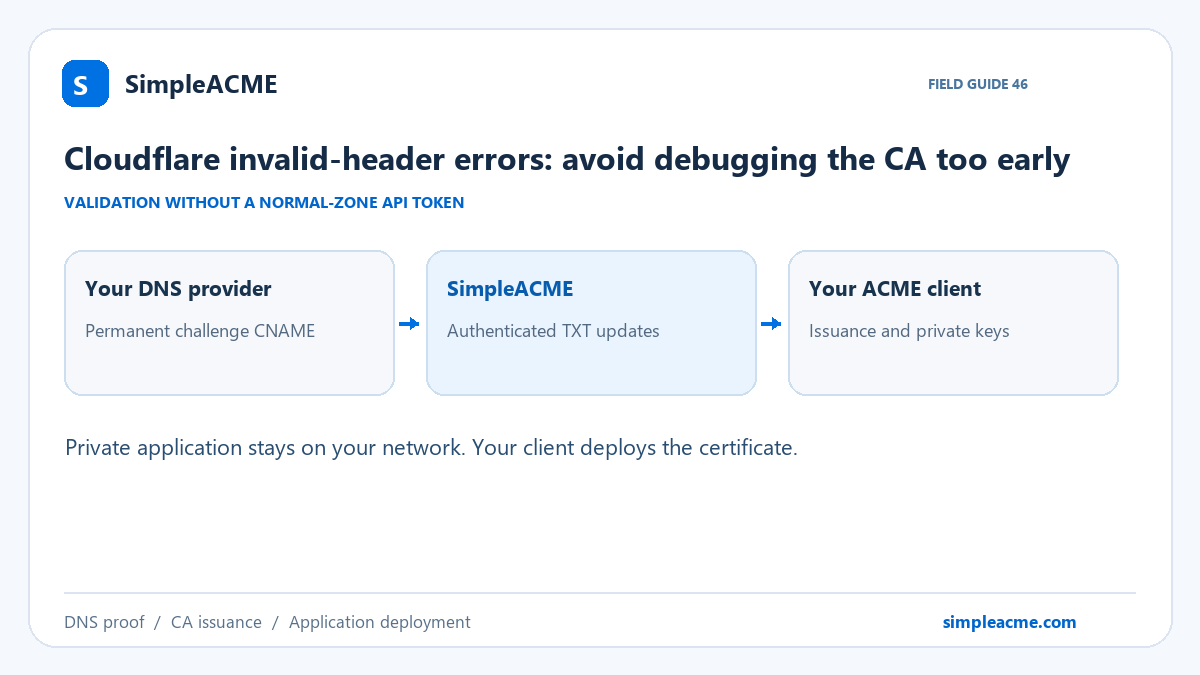
Keep registrar, DNS host and updater distinct
The company that registered a domain is not necessarily the company answering its DNS queries. Establish the authoritative nameservers before selecting a provider plugin or testing an API token. Review current provider documentation and your account's actual capabilities. A historical forum report is evidence of a failure mode, not proof that every present-day customer faces the same restriction.
Delegating just the challenge is a narrower alternative to migrating the whole zone. Your existing provider retains normal website and email records, while the ACME updater handles only the delegated validation destination. This can reduce recurring plugin and permission work. It also creates a dependency on the challenge service and the continued presence of the CNAME. Keep that dependency visible in your runbook and recheck it after account changes or a future DNS migration.
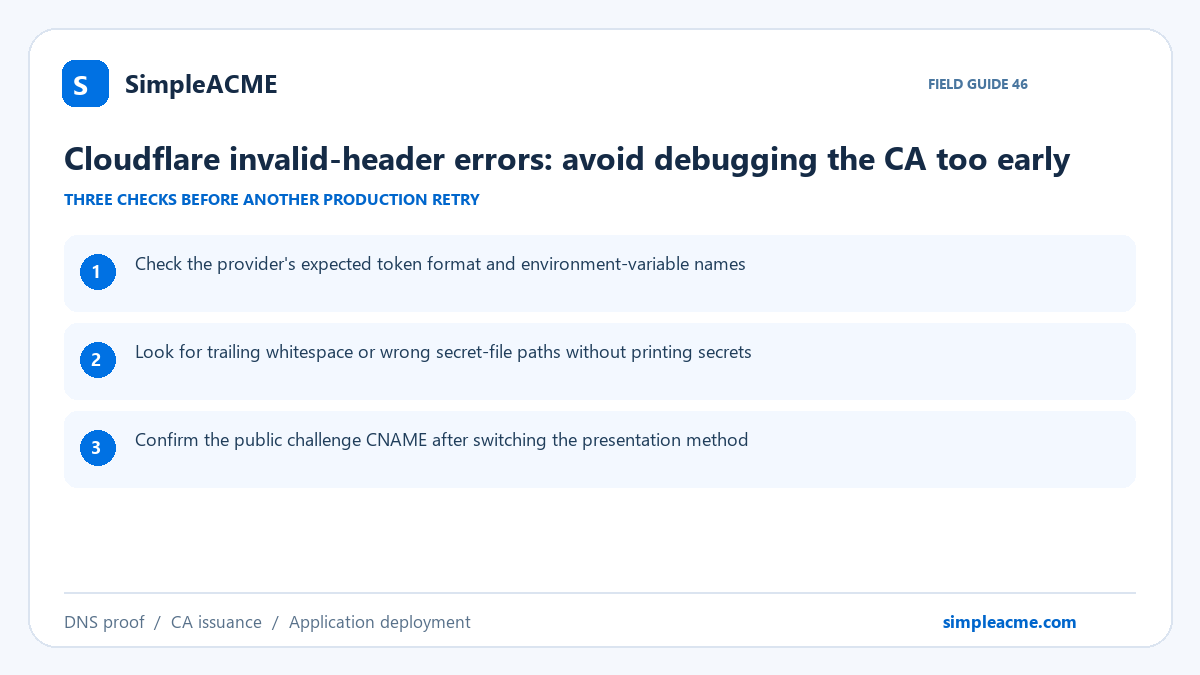
Start with these three checks
- Check the provider's expected token format and environment-variable names.
- Look for trailing whitespace or wrong secret-file paths without printing secrets.
- Confirm the public challenge CNAME after switching the presentation method.
Work through the checks against the running system, not only the configuration you expected to deploy. Save a short record of the observed answer, the client version and the first failing log message. Make one relevant change at a time so you can tell whether it corrected the original failure. Keep real credentials and private-key contents out of that record.
Configure Traefik with a stable delegation
Prepare the intended name in your SimpleACME account and copy its exact challenge CNAME. A free account can prepare one single-domain demo, but DNS updates are blocked until paid access is active. Paid single-domain and wildcard registrations follow accepted payment. Choose the required coverage deliberately; a registration or a plan label is not proof that every certificate identifier is included.
Add the CNAME at your existing authoritative DNS provider. Preserve it for later renewals, and configure the client to update the existing registration it points to. You do not need to share the normal DNS provider's API credentials with the renewal host. Your existing website and email DNS stay where they are. A CNAME is needed per distinct challenge owner, rather than one record for an unrelated collection of hostnames.
For Traefik, use the ACME-DNS provider and the existing registration supplied by your SimpleACME account. Keep the registration storage distinct from the ACME certificate storage. Configure the SimpleACME API base and the persistent ACME-DNS mapping path inside the container, select the intended resolver and attach it to the appropriate TLS router. Check your installed release's current configuration syntax.
Treat both persistence and permissions as part of the deployment. The proxy must be able to use its configured storage after a restart or container replacement. Do not delete certificate state as a routine attempt to make a browser's default certificate disappear. Inspect the actual resolver error, then test the corrected DNS presentation path in staging. For replicated or orchestrated deployments, follow the proxy's supported certificate-state architecture instead of assuming a shared writable file provides coordination.
Test the result at all three boundaries
Begin with a staging validation using a separate test certificate configuration where the client supports it. Check the final public DNS answer before asking the CA to validate. These read-only examples use illustrative names; replace them with the exact challenge owner and hostname from your own setup:
dig +short CNAME _acme-challenge.app.example.com
dig +short TXT _acme-challenge.app.example.com
openssl s_client -connect app.example.com:443 -servername app.example.com </dev/null
Then inspect the client result to confirm that the CA actually issued a certificate. Finally, inspect the certificate served by the target application from the relevant user network. Compare its names and expiration with the issued object. Test the unattended job again after a controlled restart or container recreation. Record how you would recover if the validation host or deployment target became unavailable.
Know the service boundary before relying on it
Delegation does not fix malformed credentials sent to an unrelated provider API. The client must actually select the ACME-DNS workflow after migration.
SimpleACME records TXT authorization changes and can send optional DNS-change notifications. That timeline is useful evidence, but it cannot confirm issuance or installation performed by your independent client. Keep a separate served-certificate expiry check and review update entitlement before the paid-through date. Yearly subscription billing is not the certificate validity period; let the ACME client renew when its authority and renewal policy require it.
Frequently asked questions
Does SimpleACME fix this entire problem automatically?
Delegation does not fix malformed credentials sent to an unrelated provider API. The client must actually select the ACME-DNS workflow after migration. The delegated workflow removes the normal-zone API dependency from DNS presentation. The diagnosis, client configuration and application verification described above still matter. Use the three concrete checks in this guide to identify which part of the system needs repair before changing unrelated infrastructure.
What should stay unchanged after the first successful setup?
Keep the assigned challenge CNAME, the existing registration mapping and the supported client workflow persistent. The authorization TXT value changes for new validations; the delegation normally does not. If you replace a registration, migrate the corresponding mapping and DNS record together. Recheck the public answer and complete an unattended staging test before depending on the replacement.
How do I know renewal is complete?
Treat a successful TXT update, successful CA issuance and correct application deployment as separate results. Inspect client logs, validate the issued certificate and probe the endpoint using the correct hostname. A browser showing an old certificate is a reason to inspect routing, bindings and reload behavior, even when DNS presentation worked. Maintain an independent expiry alert for the service users actually reach.
References and the next step
Use the SimpleACME Traefik guide for supported setup details and the subscriber how-to library for the reviewed configuration and script examples. Consult the primary references below for the installed client's current options. If this matches your constraints, create an account and prepare your domain, verify the CNAME, then activate the required update access before a production validation.